By Biddle Duke, The Surfer’s Journal, August 2026
It was a sparkling early dawn as we pulled up to a house on a wooded headland in Maine to grab a surfboard. Someone in our group had bought it online, and its owner came out to make small talk. We all introduced ourselves and shook hands. Pete Cabrinha went last.
“Pete, from Maui,” he said, extending his hand.
The seller, who looked as though he was in his seventies, shared that he’d surfed his entire life all over the world, but that age, aches, and ailments had slowed him down. He wasn’t getting in the water much anymore, which was why he was parting with the Robert August longboard in question.
“Pretty good waves in Maui,” he said to Pete. “You surf a lot there?”
“Yeah, a fair amount,” Pete replied.
I bit my tongue, thinking to myself, Oh, please.
The unassuming Cabrinha would never have led with his full name. He was probably also thinking what any surfer would be thinking on their way to the ocean: Let’s not unnecessarily extend this transaction.
Despite a lifetime spent riding giant, tropical waves, Cabrinha was just as keen as the frothing East Coasters in the rest of our group to surf small, chilly New England runners. The wind and tide at the right-hander at Ogunquit were just right, and there was a shoulder-high swell in the water. No time for chitchat.
Later that day, it’s worth noting, the fellow selling the board messaged the buyer: “Was that Pete Cabrinha you were hanging out with?”
*
Cabrinha is well known in the waterman world: his XXL Peahi triumph in 2004, his “strapped crew” years, his run as windsurfing’s world champion, the Cabrinha kites company. But he seems to embrace renown as a consequence, rather than a goal.
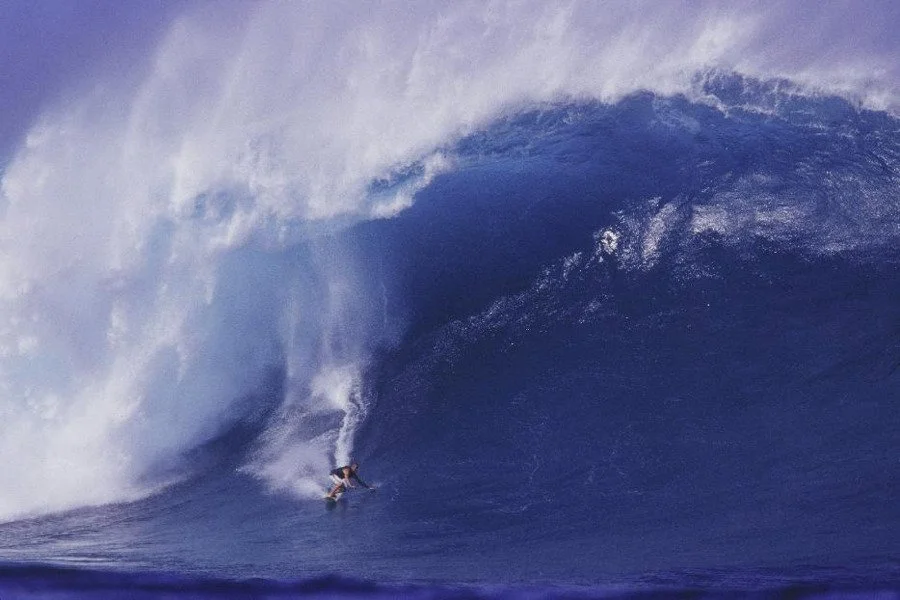
Pete Cabrinha, Jaws
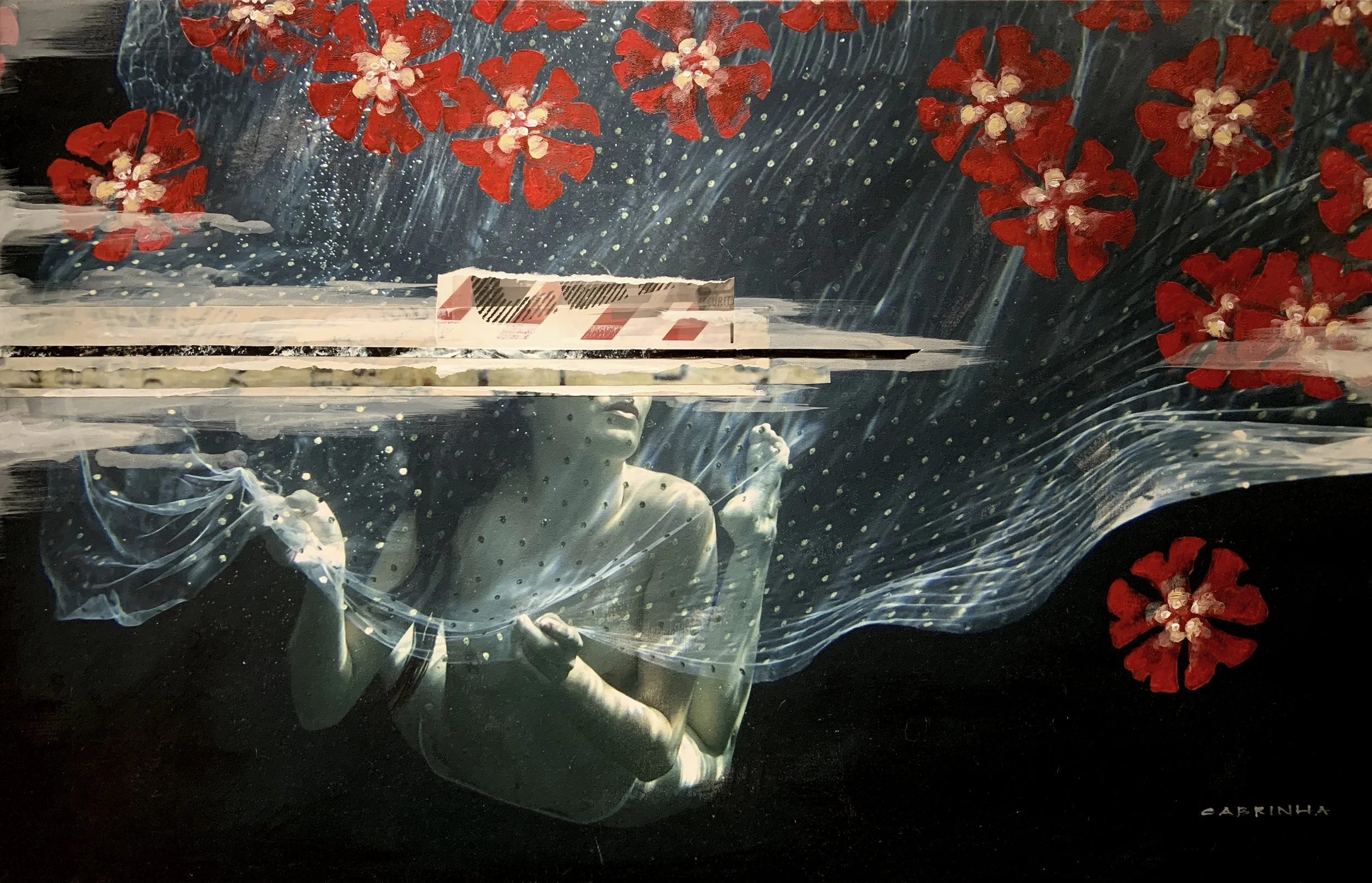
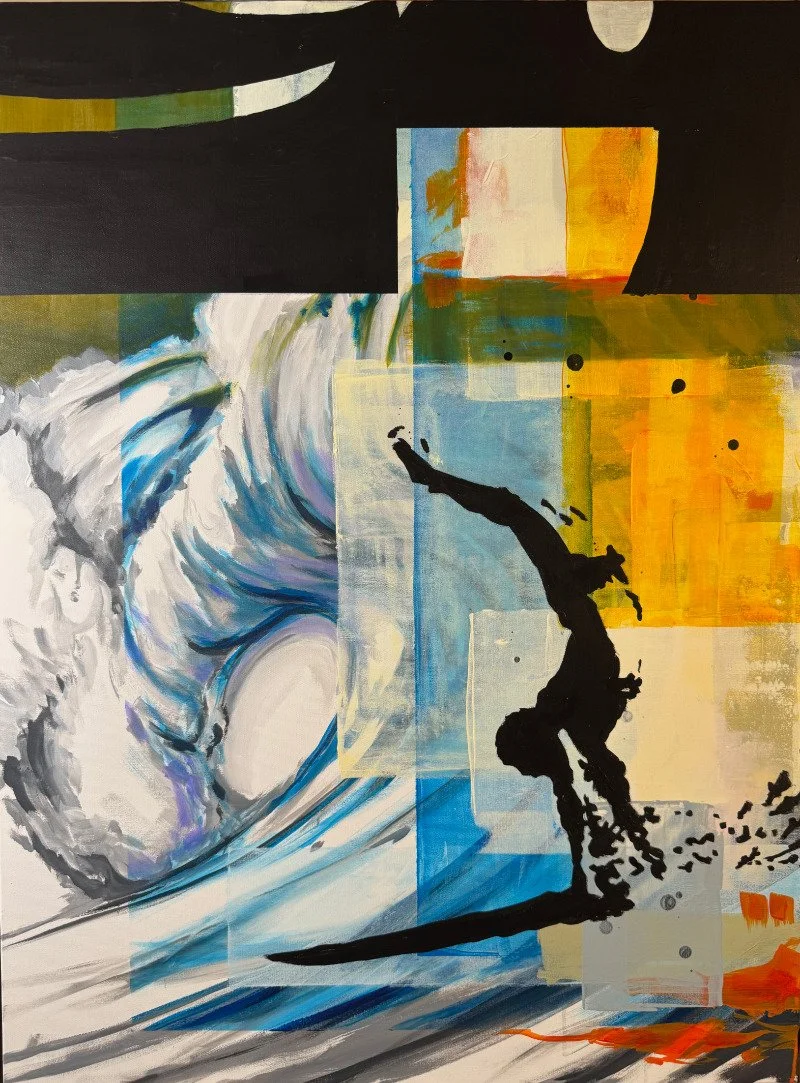
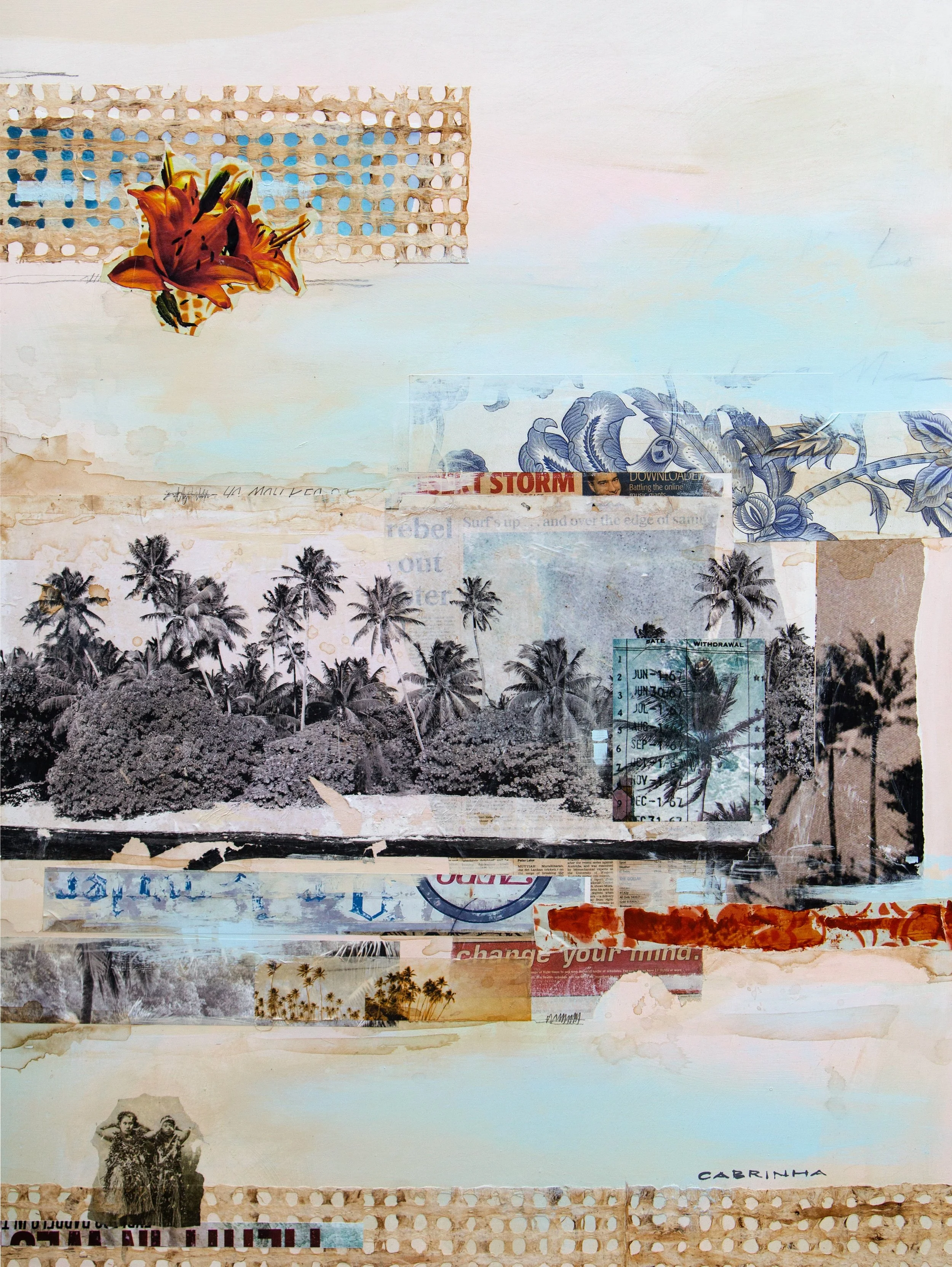
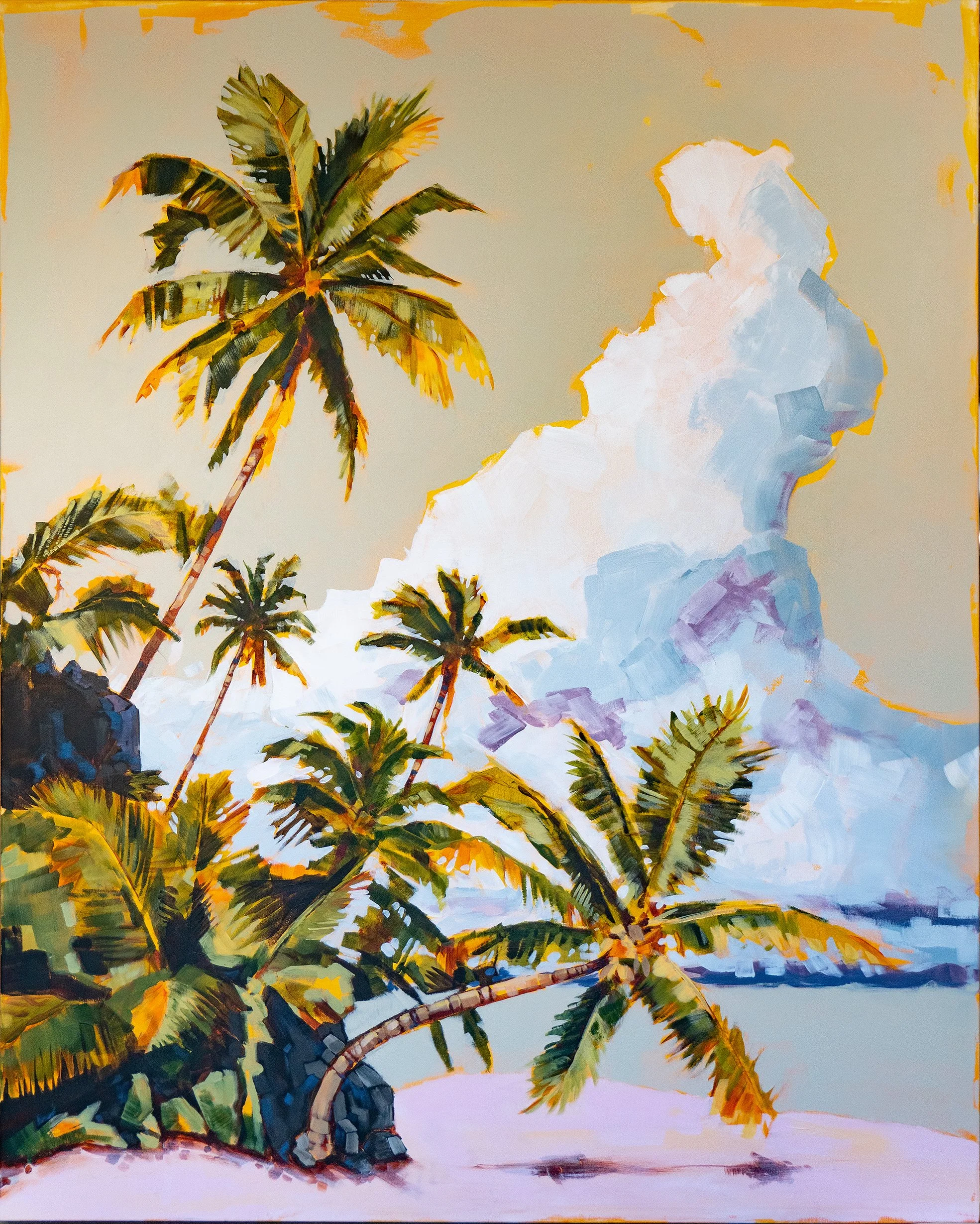
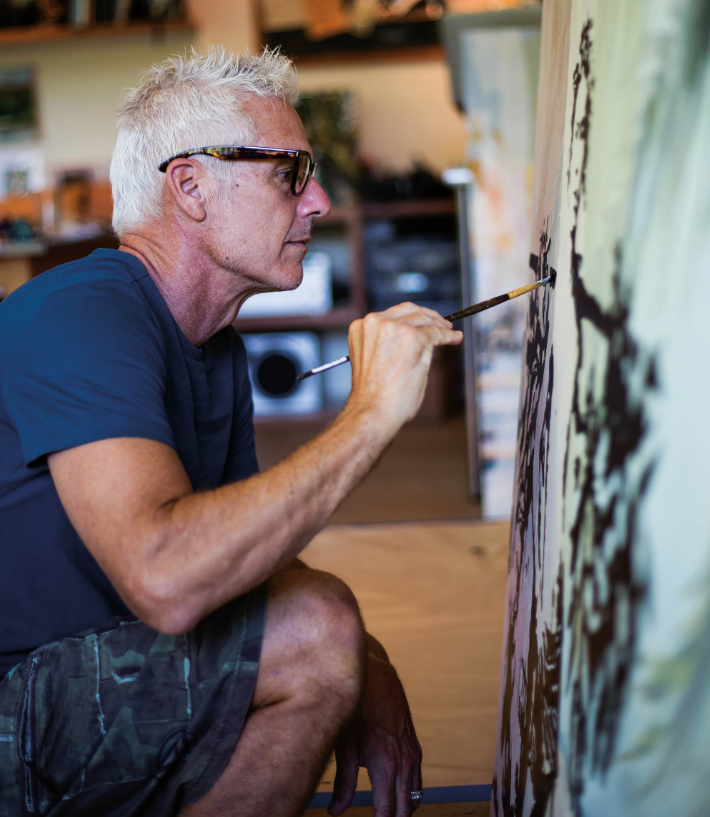
His latest venture in fine art isn’t new territory to him—he’s been an artist since he was a child, experimenting with photography, mixed media, drawing, painting, illustration. But his work, which became a primary focus some 20 years ago, is popular in part because, well, he’s Pete Cabrinha.
When I asked him how he felt about that, he shrugged a little self consciously. He’d like his art to stand on its own.
But is it possible to separate Cabrinha’s surf celebrity from his work? Collectors will inevitably examine his pieces—big, bright, dream-like, nature-inspired paintings and collages—for his story. Ultimately, part of the draw is that the work was made by one of the guys who took windsurfing to previously unknown heights, who helped pioneer Peahi, and who at one time rode the biggest wave ever.
“Yeah, I guess I have to be okay with that,” he offered with smile.
Cabrinha’s accomplishments emerged in one way or another from growing up on the east side of Oahu, and from his life later on Maui. Like many of Hawaii’s big-wave pioneers, he’s a master of all surfing crafts—paddle, wind, sail, kite, tow-in, foil—and, for that, he credits an opportunism and pragmatism born in the ocean of his youth around Kailua, with its ceaseless onshore trades and frequently blown-out surf.
Opportunism and pragmatism—and the hunt for fun—are obvious throughlines in Cabrinha’s success in the ocean, in business, and in life. But his friend and big-wave co-conspirator Laird Hamilton tells me that what distinguishes Cabrinha is his avid curiosity and bold imagination.
“Like most of us, Pete loved figuring things out, and he believed there would always be rewards for pure dedication and commitment to something you love,” Hamilton says..
It’s not hard to see the connection between Cabrinha the artist and Cabrinha the ambitious surf innovator and explorer.
“You had to be creative to have fun. I was willing,” Cabrinha says, pausing, thinking of another word. “I wanted to try everything. I always wanted to find better ways, faster ways to ride waves.”
Cabrinha and his childhood friend and Kailua neighbor Robby Naish seized on windsurfing when it appeared in the 1970s. It seemed like the right tool for Oahu’s windy east side. Naish, who would go on to become the pre-eminent windsurfer of his generation, was a few years younger, but the two bonded over their love of the ocean and began to explore Oahu together as teenagers. It didn’t take long for Maui to beckon.
The island, and the stretch of coast at Hookipa, quickly emerged as a fundamental stepping stone to riding the biggest waves on Earth.
“It felt like the whole world just arrived there from one day to the next. It was like that coastline had been designed for windsurfing,” Cabrinha says.
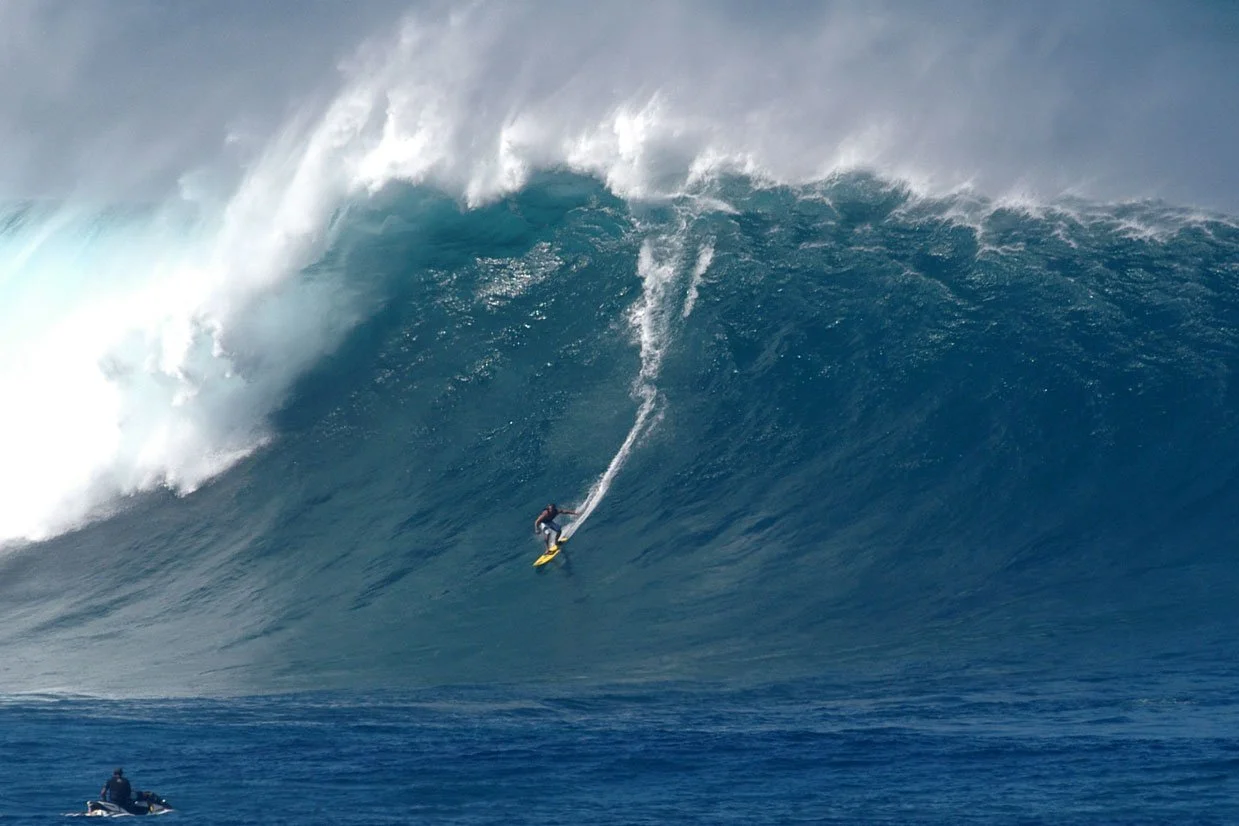
Cabrinha, just another day at Pe’ahi (aka Jaws) on Maui
By 1980, just out of high school and living on Maui, Cabrinha was pushing windsurfing to its limits. He was making ends meet shaping boards. Photos of his aerial wave-riding feats were appearing in magazines. After noticing posters of himself that had been made by a Japanese company, he wrote them, inquiring about compensation. The company wasn’t ready to pay him, but they invited him to Japan to compete in the world windsurfing championships in Okinawa in the fall of 1981.
As luck would have it, a typhoon whipped up the very week of the contest, forcing the organizers to retreat from the coastline and cancel events. But the surf from the advancing storm looked like pure fun to the Hawaiian. Cabrinha sailed out into the maelstrom.
The press was there, and photos of Cabrinha at play in the giant typhoon-lashed ocean appeared in all the dailies in Tokyo. He became an instant legend. His corporate hosts put him on the marketing payroll.
Just 20 at the time, Cabrinha was soon competing around the world, often winning in the windsurfing “wave performance” category. He was crowned world champion in 1985.
At the same time, he was deepening his business involvement in the sport, using his skills in graphic design and marketing, working with Naish on his growing self-named windsurfing company. But whenever he was back home on Maui, his attention would turn to the surf, and toward experimenting with a local crew of talented and ambitious surfers—the strapped crew, many of whom would contend that windsurfing was the keystone in the trajectory between paddling into big waves and towing into them.
Big-wave surfing was fast progressing on multiple fronts in the 1980s and early 1990s—in equipment and technique, in new breaks being pioneered around the world—and windsurfing was part of that evolutionary push.
“We were catching waves on windsurfers way earlier than was ever thought possible,” Cabrinha says, “making sections we didn’t think we could. The tow-in thing was just the logical progression, the next step.”
The elite Maui crew came together, drawn by mutual respect. “We congealed naturally,” Hamilton says. “I would describe that group of men that included Pete as the most talented watermen in the area at that time.Those were the guys to pull from if you were going to go on an adventure.”
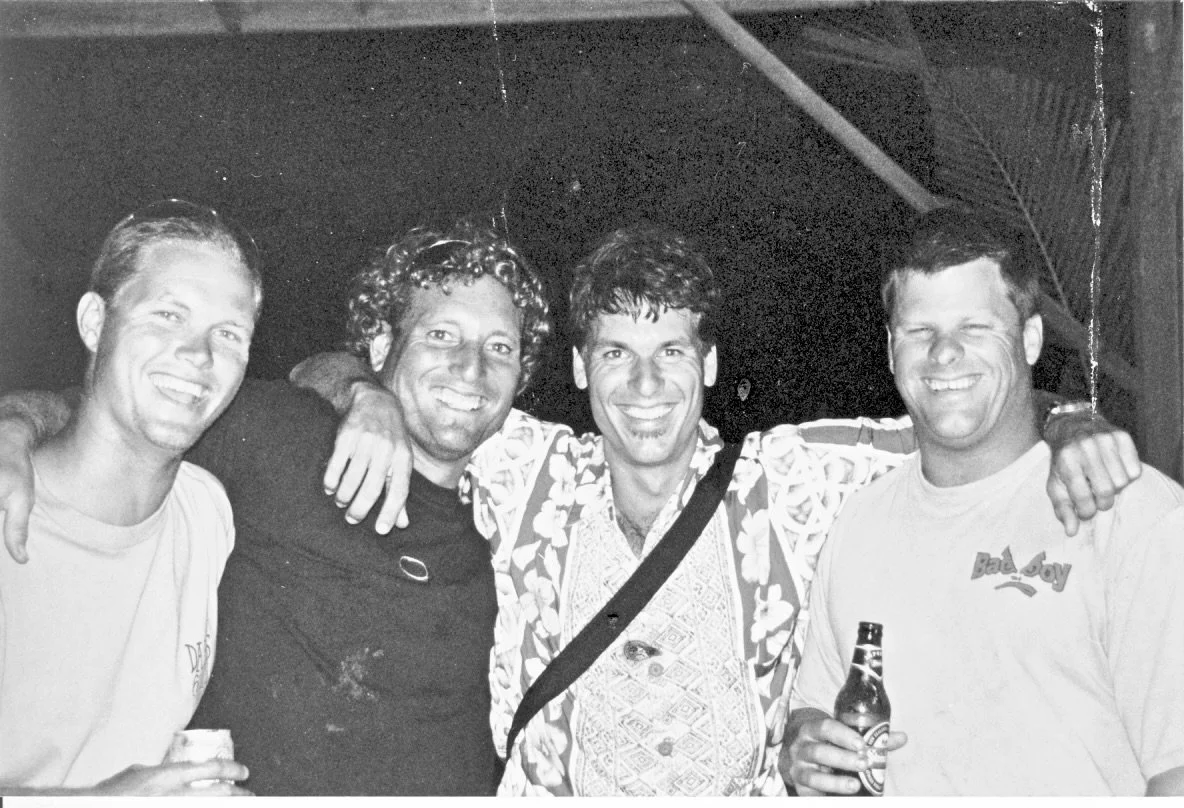
A Few of the Strapped Crew, 1990s, from left: Mark Angulo, Dave Kalama, Cabrinha, and Brett Lickle at a Luau for Kalama’s son Austin.
Peahi was the most obvious new frontier. Cabrinha had gotten his first look at the wave in the late 1970s with Maui big-wave hellman Steve Haller, who’d been eyeing it for a few years. They made their way out through the pineapple fields that day to a dome-shaped house that overlooked the break. The lineup was empty. (A clutch of locals had begun to surf the place, but they were few in number and kept it quiet.). “It was pretty solid, about 40 foot,” Cabrinha says. Still a teenager at the time, he didn’t surf it that day. He doubted he’d ever ride it. It would be more than a decade before he worked up the courage.
Hamilton, Buzzy Kerbox, and Darrick Doerner had a first run at towing-in on Oahu’s outer reefs in 1992. Eventually turning their focus to Peahi, they were joined by the rest of the strapped crew, including Dave Kalama, Brett Lickle, Mike Waltze, Rush Randle, Mark Angulo, and Cabrinha. All of the principals lived on Maui at the time, with the exception of Doerner.
“For a long time it was mostly just us” at Peahi, Cabrinha reflects, “from about 1993 to the end of that decade.”
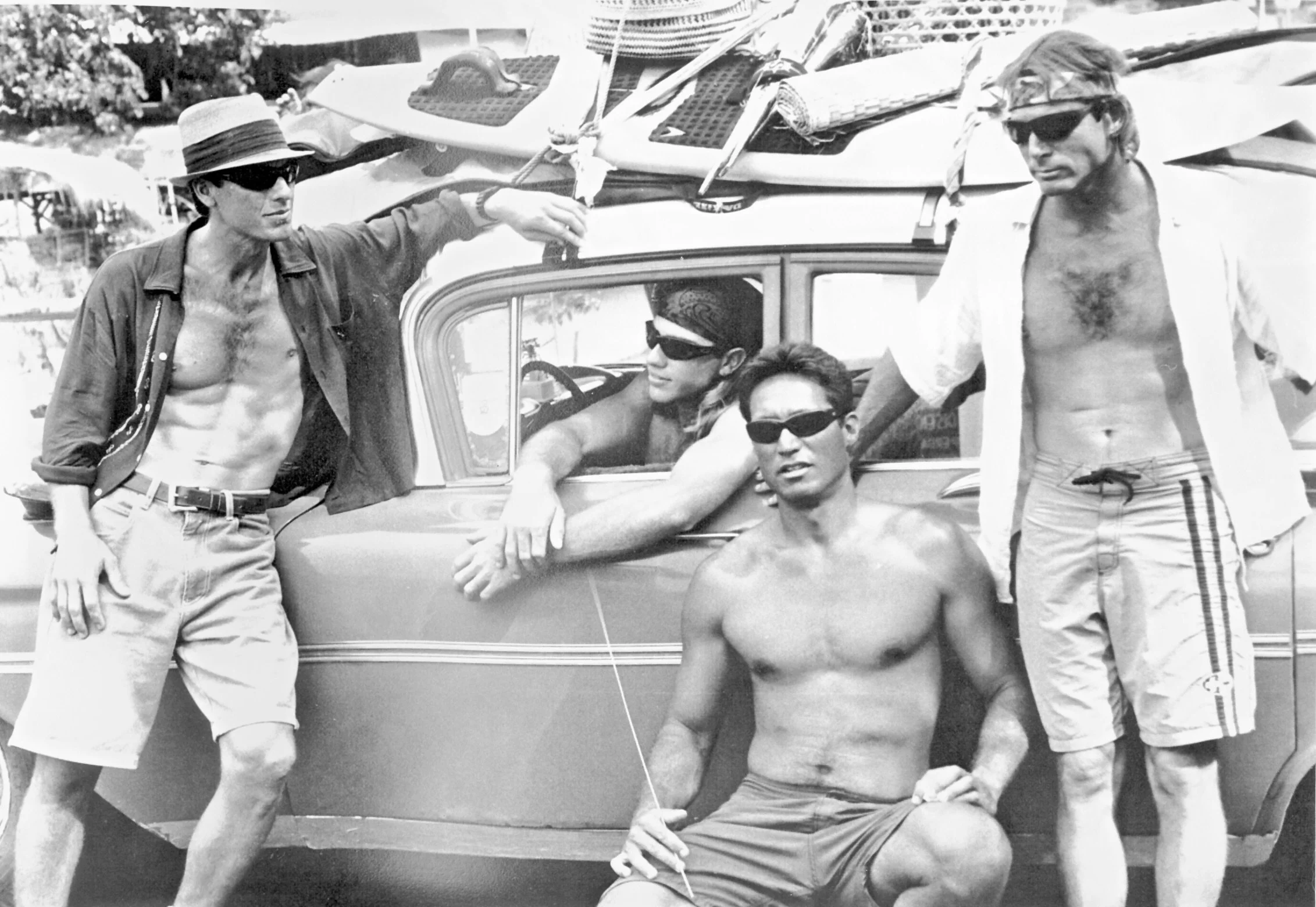
Some of the Strapped Crew, 1990s, at an outdoor food market in Denpasar, on the set of the film "in Gods Hands". From left: Cabrinha, Rush Randle in the car, Brian Keaulana, and Darrick Doerner.
A 1994 Surfer magazine cover shot of Cabrinha and Hamilton, under what looks to be a 50 or 60 foot Peahi lip, declared: “Strap in, take off, shut up.” Hamilton and Cabrinha had been towed-in together on two separate ropes attached to a single jetski. Hamilton had initially decided to go left and he waved Cabrinha onto the right. But the left loomed up into what looked like a closeout, so at the last minute he changed his mind and followed Cabrinha.
“I didn’t even know he was there,” Cabrinha recalls.
A few seconds after the photo was taken, Cabrinha was able to pull into the barrel and make the wave. Hamilton was not so lucky.
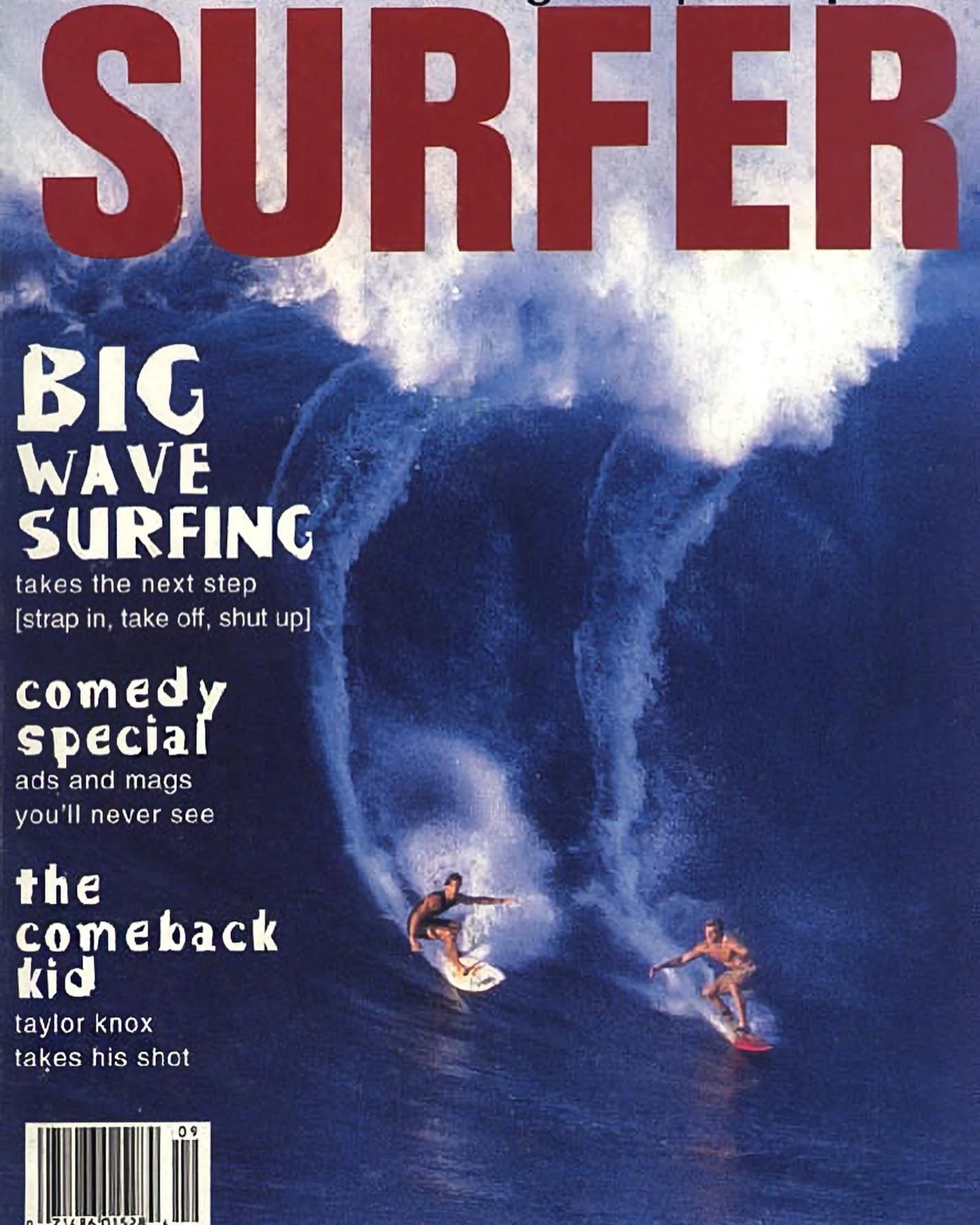
Surfer magazine cover, 1994
With each session they learned something new. They went out in surf trunks without flotation, on underpowered watercraft. Then they upgraded. They devised safety protocols and intelligible signaling between driver and surfer, and designed tow-behind sleds which have become essential equipment.
To Cabrinha, what was evolving back then seemed instinctual and reflexive. “We were just looking for ways to expand the fun, ways to keep up that momentum, always dealing with the conditions that were there,” he says.
“Everybody had their roles,” Hamilton says. “There was a level of respect, which kept the egos at bay, and enabled us to pursue the challenge together and look out for one another. That was the dynamic that created the courage we needed.”
By January of 2004, the tow-in scene at Peahi was full on. The opening shot of the season was a two-fer, two swells back-to-back. Randle and Cabrinha motored out, unsure of what they would find. It was a chaotic scene, more than 30 skis, crowds lining the cliffs, helicopters overhead, guys getting towed in two, sometimes three per wave.
“We decided to just watch,” Cabrinha says.
Eventually, noticing lefts going unridden, they went over to take a look. Cabrinha was on a new board he had never ridden before, and was unsure about it. A set loomed. He passed on the first two, then Randle pulled him into the third one.
“It looked good, it was big for sure, but it was hard to tell the size.”
The record-keepers called it a 70 footer, the biggest—tallest, that is—wave ever ridden at the time. Cabrinha knew he’d caught a giant, but he was still surprised when, later that year, Billabong awarded him the XXL prize and $70,000.
Reliving that moment now, Cabrinha maintains it was never his intention to be one of the world’s leading big-wave riders. He was just a Maui local tackling the biggest surf challenge in the neighborhood. Regardless, the race was on, and his ride and wave were part of it.
“Suddenly we realized, there wasn’t a wave in the ocean we could not catch,” Cabrinha says.
(His 70-foot record held for a few years. The record now stands, astonishingly, at more than 90 feet.)
“They broke the mold, and laid the groundwork,” says today’s pre-eminent heavy-wave innovator Kai Lenny.
Cabrinha describes a sort of mission accomplished feeling about that time. He’d never been interested in chasing giant waves around the globe. Surfing Peahi had called appealed to him because it was on Maui and, like an awe-inspiring nearby summit that had yet to be explored, its challenge had beckoned.
“What drew me in was (that) I was fascinated and enthralled with the whole exploration of it, the challenge of figuring it all out,” he says.
One expression of creative courage — some might even say of hope — is to defy convention, to step beyond known and established limits.
“I really enjoy looking at things not exactly for what they are, but for what they could be, or for how I could frame this thing I am seeing in a different way, in an interesting way, in a way that might be interesting to me or even interesting to a viewer,” Cabrinha observes in one of our conversations.
He could be talking about surfing Peahi. But he isn’t. He’s talking about his art.
At 64, Cabrinha, unsurprisingly, has the slender, muscular physique of a younger man. He’s slight, compact, his gaze intense. Clear-eyed and undeniably handsome, the brown hair of his youth is white now and cut short. He lives on Maui with his wife of 32 years, the clothing designer Lisa Letarte Cabrinha. Like every surf vehicle that came before, he’s seized on foiling, and he surfs and foils and kites in the mornings, before he turns to making art, which he’s been focused on in earnest since 2004.
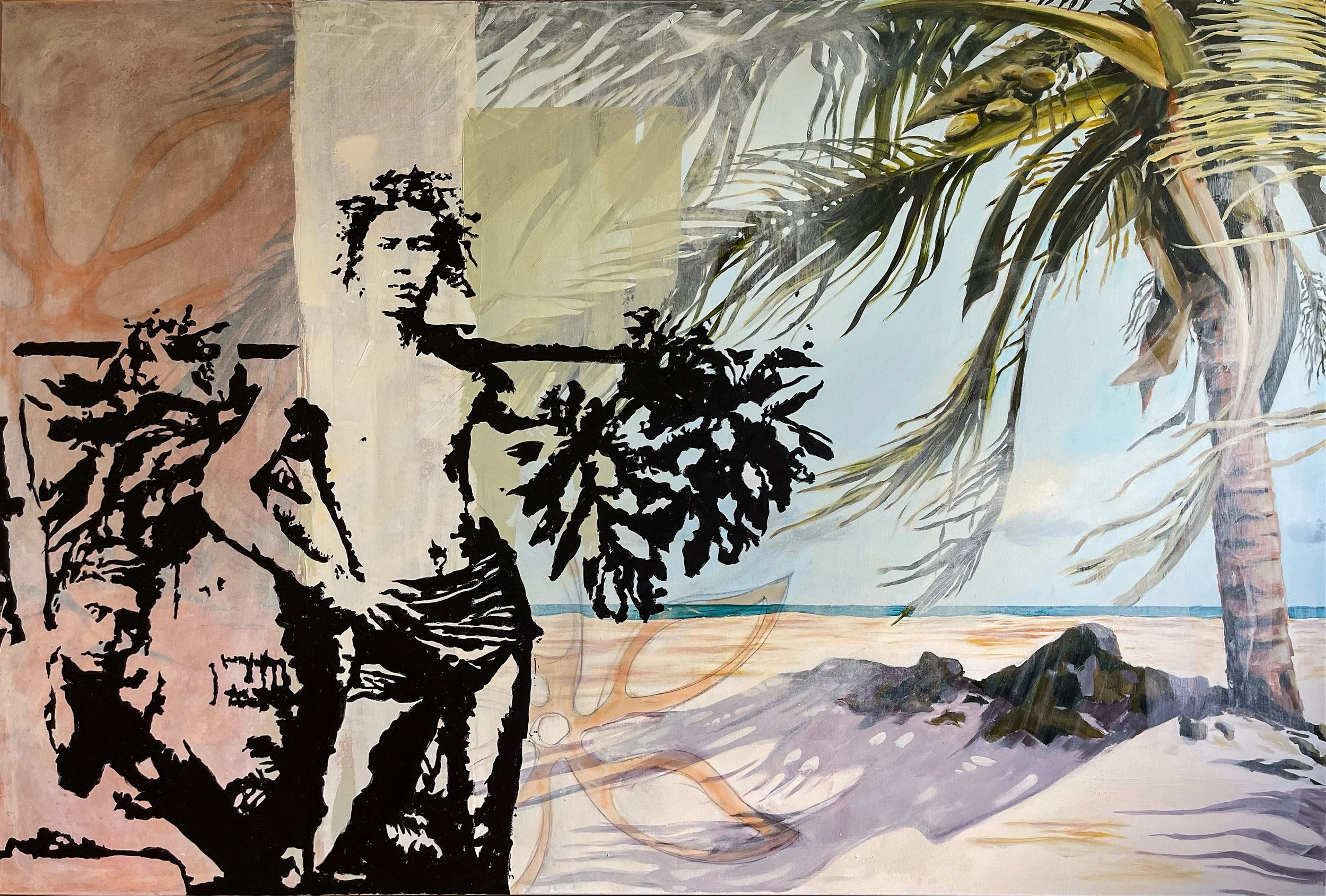
It would be inaccurate to describe Cabrinha’s work as painting. There is almost always paint involved, but the work also combines photographs—his own and archival—and collage. Much of his latest work captures the motion of wind through sun-speckled palm fronds. His themes are powerfully Hawaiian, moody, nostalgic, surf-inspired, featuring tropical landscapes.
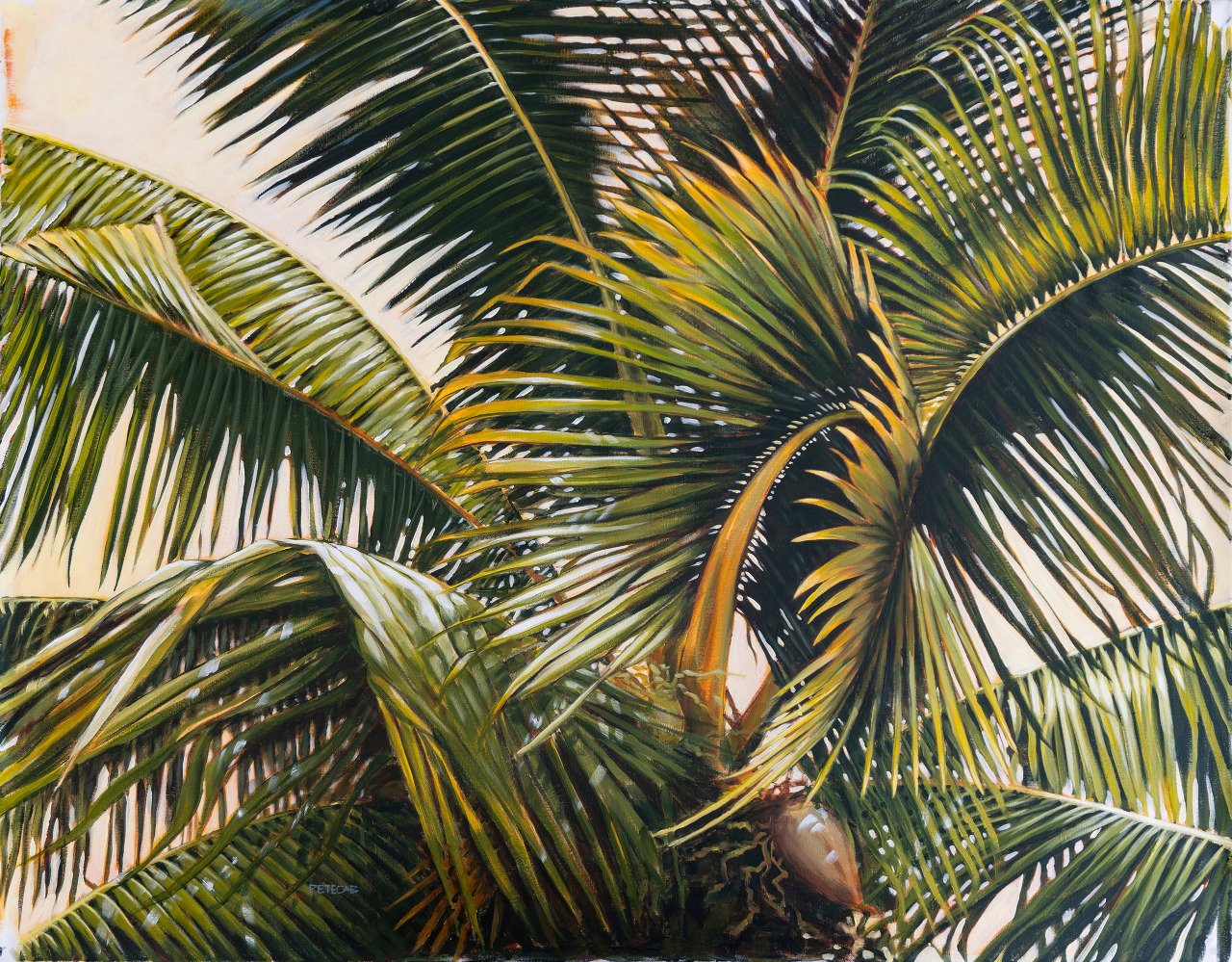
Some of his work includes layers of images and figures, offering a sense of mystery, perhaps a personal narrative. Cabrinha’s Hawaiian roots are complex, wide and deep. He is descendant on both his mother and father’s side of the family from Portuguese immigrants who came to the islands—settling on the Big Island on his father’s side, and on Kauai on his mother’s side—in the 1800s mostly from Madeira and the Azores, drawn by the promise of work in the sugarcane fields.
It wasn’t until a visit to Molokai when Cabrinha was a teenager that he learned that his father had been separated at birth from his mother, Minne Chaves. Under the law at the time, pregnant mothers with leprosy, also known as Hansen’s Disease, were never even given a chance to touch their newborns before they were exiled to Molokai’s Kalaupapa Settlement to live out their lives in isolation. Hawaiians like Minne Chaves inflicted with the disease lost everything.
To this day, he doesn’t fully understand why his parents waited so long to share their family history with him. The legacy of Hawaii’s leprosy epidemic is tragic, and shrouded in shame and secrecy. But beneath that are stories of love, dignity, and resilience.
Cabrinha’s father, Lawrence, was raised by friends—the Cabrinhas, who adopted him under the traditional Hawaiian system of hanai, an informal but permanent form of adoption rooted in the deeply held belief that rearing a child is the responsibility of the ohana, the extended family and community.
Lawrence Cabrinha himself didn’t know about his blood parents until he went to register for the draft in the 1950s and discovered the “Chaves” name on his birth certificate. Lawrence Chaves Cabrinha would go on to have a huge life as a commander and fighter pilot with the Hawaii Air National Guard, flying F-15s, then later as a pilot for Aloha Airlines, and as a husband of 62 years and a father of four.
Minne Chaves had several children before bearing Lawrence Cabrinha. So, for Pete, his father’s hanai adoption gave him a large, extended family of both Chaves and Cabrinha uncles, aunts and cousins spread across the Hawaiian islands, a vast ohana.
He carries a photo of his grandmother Minne close. Alongside it is another, of his great aunt on his mother’s side, a Franciscan nun, who worked at Kalaupapa in her twenties (long after Minne died). The grainy image shows a woman standing on the rocks on the shores of the settlement holding a fishing rod. She was known as the “fishing nun”— whatever she caught became dinner at the colony.
It’s impossible not to sense this history in the moody, wistful nostalgia in many of Cabrinha’s paintings. “I have such a sense of reverence and pride in this place,” he says, “especially from the time I grew up here, during the 1960s, before so much changed.”
Despite so much connectivity in his work, his life, and his family history to the Islands, a few years ago, Cabrinha and his wife, Lisa, fell hard for Vermont, a place a world away from his roots. Their daughter had decided to attend the University of Vermont in Burlington and, on a visit, the Cabrinhas connected with old friends in the nearby mountain town of Stowe.
For Lisa Cabrinha, originally a New Englander, she was coming home. They found a small house, got good at driving in the snow and stoking the woodstove, and began spending part of the year there, working, snowboarding, and exploring the New England coast.
Cabrinha, now an avid snowboarder, has become a regular in the crowd assembling right after dawn at the main chairlift at Stowe, waiting for it to spin. In the afternoons, after a morning exploring the state’s highest summit, Mt. Mansfield, he turns to his art.
“When did you begin to call yourself an artist?” I inquire after one of those days. His answer is philosophical. His mother made art, he grew up drawing. He spent decades observing the ocean in all its moods, asking himself, What can I do with that?
I guess the way I see the world around me is as an artist,” he says. “But the label, ‘artist?’ In surfing you have this thing, you know, the ‘waterman.’It’s not really good form to call yourself a ‘waterman.’ Other people might say that about you. It’s a humility thing.”
The “artist” label is a bit like that, he implied.
“But in terms of how I feel about myself and understanding the way I look at life now?” he adds, “if someone next to me on a plane asks what I do, for simplicity I tell them I’m an artist.”