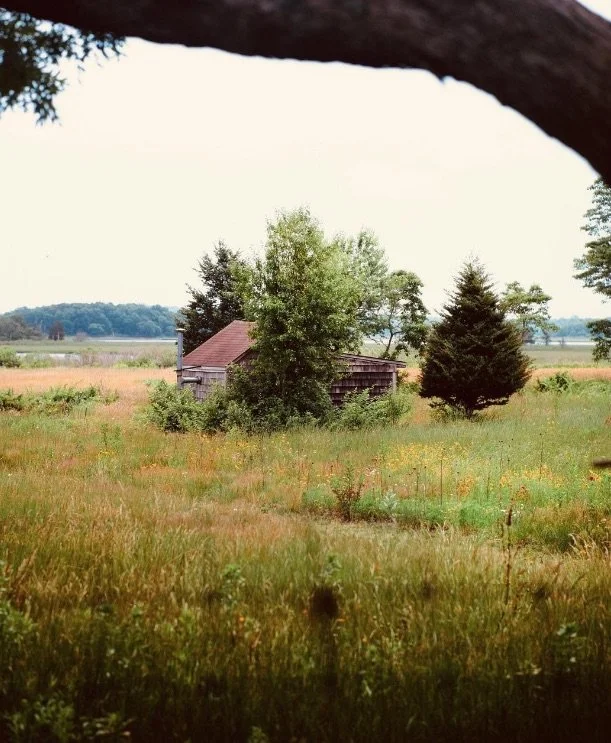
Photo: Accabonac Harbor, Springs, 2021, by Andrew Blauschild
Dear Sis,
I hope you’re staying cool out there in California. Here, it’s been a sweltering summer in full, nutso swing.
A snapshot: Out on the roads it’s either a racetrack among distracted, late-modeldriving people in an endless hurry, or it’s a parking lot. The money’s-no-object-crowd is paying $300 for melons from Japan and wooden marshmallow sticks for $45 at the Sagg General Store. I kid you not: Four-dollar garden stakes with pointy ends for $50 after taxes that probably end up in the fire at the end of the night. Burning money.
But, God forbid, we should raise these people’s taxes to lift fellow Americans out of poverty or give someone a needed meal.
What a strange place this is for the few warm months, the “Hamptons,” as most people call it now, a brand, a synonym for excess.
I drove home the other day. By that I mean I drove from my house in Springs to Southampton. Southampton — “all my changes were there,” as Neil Young so poignantly wrote of his own childhood home; home, where one launches from the innocence of youth.
It takes more than an hour this time of year to cover the 18 miles. I settled in for the sights — and the memories.
I went the long way, through Sag Harbor and Noyac, down Millstone Road, past what was once Tony Tiska’s farmland off Lopers Path. I remember going there with him sometime in the late 1980s.
I was a kid reporter then for this newspaper, covering the carving-up of hundreds of acres of farms north of Bridgehampton and Water Mill into lots for mansions. Tony was thinking of giving up farming. He was the vice chairman of the Town Planning Board. He’d taken a shine to me and was trying to be helpful to this greenhorn reporter. I admired him, his friendliness, his generosity. I was grateful that he was taking me in.
I remember standing by his potato fields — now a polo club — as he shared his family story. His grandparents had arrived from Poland in the early 1900s. His dad went to work as a teenager for other farmers, and tending greens at the Maidstone Club, eventually scratching together what it took to buy the land we were standing on and that Tony himself was then farming.
Tony was smart and thoughtful, handsome and fit, with a shock of blond hair, an athlete, easy to talk to. I remember him telling me flatly, with sadness, that it was over for potatoes, for the kind of farming that he wanted to do. He saw what was coming: The Hamptons. He was thinking of selling his land. He eventually did. It was controversial.
A few years later, I received a letter from my former boss, Peter Boody, the editor at The Southampton Press. The era before email. I read that letter at my desk in the newsroom in New Mexico, where journalism work had taken me. Tony had taken his life, Peter wrote. Peter knew I would have wanted to know.
The news stabbed me. I was struck with confusion and sadness, and disillusionment. How little I knew of life then, and of my friend Tony Tiska.
I made the turn on Wickapogue, past what used to be the Ford place, past the Fowlers’ farm, down the long, straight stretch toward the hospital. The road rises slightly where Lyle Foster lived and where the Nugents still have a house on the north side of the road. The rise always comes with a shiver — the spot where Dad was hit by a car and killed instantly.
Forgive me, Sis, all this about good men gone. But aren’t thoughts of home inevitably punctuated by both painful and instructive endings? — and, yes, yes, joyful beginnings.
I turned up Old Town toward the beach, and there was that big, white stucco wall running up the west side of the road. Do you remember the mythical Murrays? They had their own wonderful world behind that wall. That’s how it felt as a kid who was never invited in.
The Murrays — what a fascinating dynasty of a family, descendants of the great inventor Thomas E. Murray, who had over 1,000 patents. They had a slew of houses on their compound that extended from Wickapogue to the ocean.
In my memory, all those Murray cousins were athletic and impossibly good-looking. I guess I betrayed my crush on one: She always shoots me a knowing look on the rare occasions these days that we bump into each other.
They’re all scattered now, the Murrays, the compound chopped up and sold. I’m told George Soros and his family and Howard Stern own houses there.
Have you watched the Murray family story, the engaging documentary “Dad’s in Heaven with Nixon”? I hear the rest of the story will come out shortly in Tommy Murray’s soon-to-be-released book (spring 2027), “The Murrays of Southampton.”
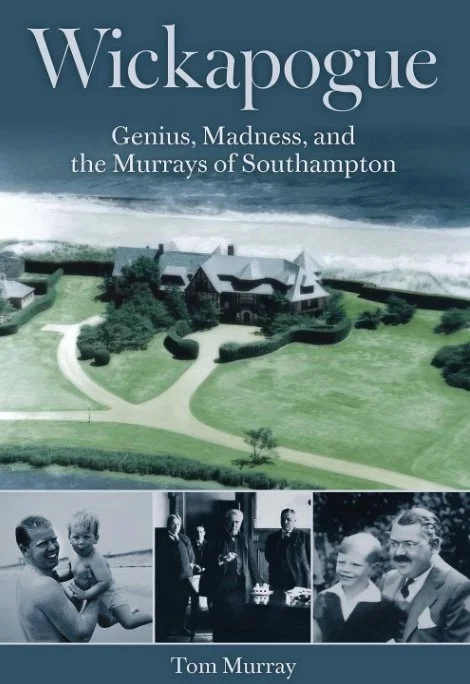
Photo: Wickapogue — The Murrays of Southampton, book cover courtesy of Tom Murray
When I turned onto Gin Lane, I got to thinking about all the arguments I had about that street name. Most people think it was for the booze. It’s not. I’m somewhat defensive about it. “Gin” is an old-English word that means an enclosure for farm animals. Yeah, yeah, me, again, pushing back against “The Hamptons.”
I stopped outside the Southampton Bath and Tennis Club at Little Plains Beach. It’s super fancy now compared to when irrepressibly cheerful George Semerjian owned it. Do you remember my best friend Tony Houseman? His mom was the manager of the place when we were kids: Marianne — she was Dutch, devoted, smart, a hardworking single mom.
Tony, his gorgeous twin sister and Marianne lived in the attic. At night, Tony and I would sleep with all the windows wide open, the sound of the ocean echoing off the ceiling.
Tony was a brilliant athlete and surfer. He grew up in the Caribbean, where his mom worked in the winters. He turned me on to Gregory Isaacs.
One December, when we were in our late teens, Tony and two other friends drove down the west coast of Morocco in a Peugeot station wagon, looking for surf. We slept out in the desert under blankets on a carpet that traveled rolled up on the roof. A much longer story for another time.
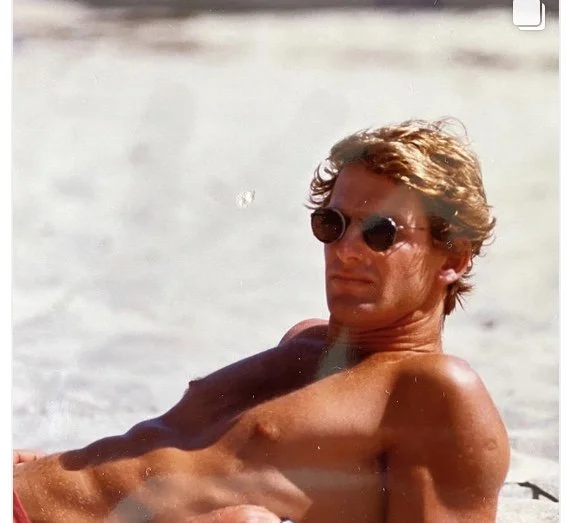
Photo: Tony, probably early 90s
Damn, Tony and I fell out of touch, until some years ago, when we reunited for the first time in years. We had a sweet conversation; he told me our time together was the happiest of his life. I was touched, but the remark struck me hard as oddly sad. He died days later. He hadn’t said a thing about being in ill health. I could have been a better friend.
Did you know the word “nostalgia” means homesick, or, more specifically, the misery of missing home? It was coined by a Swiss medical student documenting the symptoms among soldiers fighting in far-off places. He combined the Greek words nostos and algos, “homecoming” and “suffering.”
Do you think grief is love?
Write back.
Biddle
— Biddle Duke The Express News Group (The Southampton, East Hampton and Sag Harbor newspapers), August 2026.